
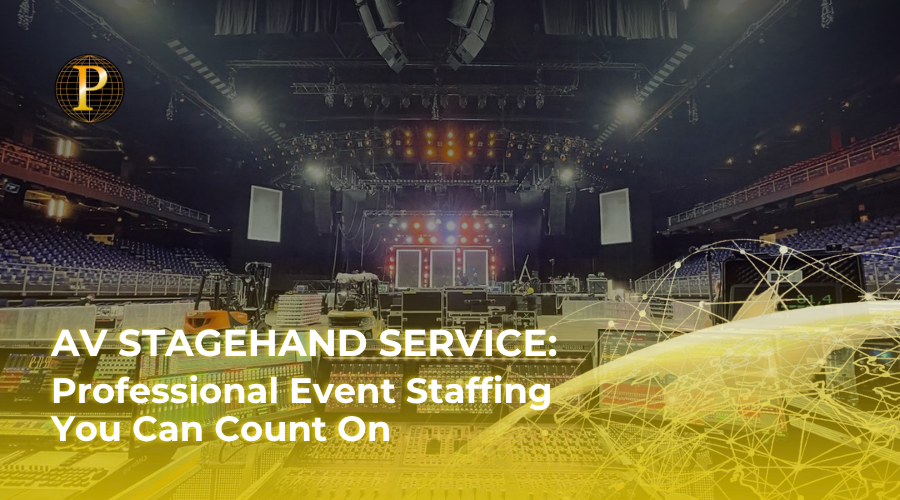
Audio visual services are the backbone of every event that looks and sounds professional. From the mic on the keynote stage to the LED wall behind it, someone has to make all of it work in real time. So let me walk you through what audio visual services really include, why the crew behind them matters more than the gear, and how to make sure your next event runs without a hitch.
Here is what most planners learn the hard way. The equipment rarely decides whether a show succeeds. The people running it do.
What Audio Visual Services Actually Include
Audio visual services cover the equipment, setup, and skilled labor that bring the technical side of an event to life. In other words, they handle everything your audience sees and hears, from sound and video to lighting and staging.
On a typical event, that spans a lot of ground. For example, it includes audio for microphones and speakers, video for screens, projection, and IMAG, lighting for the stage and presenters, and the crew who set it all up, run it live, and strike it after. Some providers focus on gear and design, while others focus on the skilled labor that makes everything run. The best events combine both.
That labor is the piece people underestimate. You can have flawless equipment, but without experienced technicians operating it, problems go unsolved the moment they appear.
Why Skilled Labor Powers Great Audio Visual Services
Great audio visual services live or die on the people behind them. Equipment does not ring out a room or catch a failing feed. Trained technicians do.
Consider a live general session. A good A1 hears feedback before the audience does and fixes it in seconds. Meanwhile, a sharp V1 has the backup feed ready before anyone notices the primary stuttered. When a presenter goes off script or a laptop refuses to connect, an experienced crew solves it in real time, without the room ever knowing there was a problem.
That quiet competence is the real value. When your audio visual services are staffed right, the technology simply disappears and the event just works.
How Audio Visual Services Scale to Any Event
No two events need the same setup, so strong audio visual services flex to fit. This holds true whether you are running a small breakout or a multi day general session.
A simple room might need one experienced tech to manage audio and presentation support. A large production, on the other hand, needs engineers in the key roles plus enough technicians to cover audio, video, lighting, and utility work. Therefore, the skill lies in matching the right crew to the actual demands of your show. A labor coordinator keeps everyone aligned, so nothing slips through the cracks during transitions or strike.
Because the right partner scales with you, you never overpay for talent you do not need. Likewise, you never get caught short when the stakes are high.
How to Choose the Right Audio Visual Services Partner
Every provider promises experienced, reliable crews. Therefore, you have to look past the pitch. A few questions cut through it fast.
First, ask how they vet their technicians. A serious provider verifies real show experience and checks references, rather than pulling names from a database. Second, ask about their backup plan when a tech calls out on event day. The strong ones keep bench depth ready. Third, ask whether they actually staff your market, or whether they will subcontract to people they have never worked with.
The answers reveal everything. A company that lives in live events answers clearly and confidently. One that is stretching outside its lane gets vague.
Why Prestige Labor Solutions Supports Your Audio Visual Services
This is exactly the gap we built Prestige Labor Solutions to fill. We are not a general staffing agency that dabbles in AV. Instead, live event production labor is our entire business, and that focus shows on the floor.
Every technician we send is vetted for real production experience and matched to the role your event needs. That might be a full crew of engineers and techs for a multi day general session, or a couple of strong utility hands for a quick strike. Better still, we speak the language of your show, from A1 and A2 to V1, FOH, IMAG, and RF coordination. Because of that, you will not spend the morning explaining basics to the people you hired to make your job easier.
Comments are closed